Choosing where to pursue a degree in Global Studies, International Relations, or a related field is as crucial a decision as selecting the university itself. The right city acts as a living laboratory, a dynamic extension of your classroom where theory meets practice. It’s a hub of international organizations, diplomatic activity, cultural institutions, and diverse communities that provide unparalleled practical experience and networking opportunities. This comprehensive guide delves into the world’s premier urban centers for aspiring global leaders, analyzing what makes each unique beyond just university rankings. We will explore the academic powerhouses, the professional ecosystems, the cultural fabric, and the lived experience that define these top-tier destinations for a world-class education in global affairs.
Why Your City Choice is Critical for a Global Studies Degree
A Global Studies degree is inherently interdisciplinary, drawing from political science, economics, history, sociology, and language studies. The ideal city amplifies this learning by offering:
A. Proximity to Power and Policy: Being in a capital city or a major diplomatic center means access to government agencies, embassies, think tanks, and international organizations. This facilitates internships, guest lectures from practitioners, and potential employment pathways.
B. A Multicultural Microcosm: A truly global city is home to a diverse population. This daily immersion fosters cross-cultural understanding and language skills, which are indispensable assets in this field.
C. Networking Nexus: Conferences, policy debates, cultural events, and professional meet-ups are the lifeblood of a global career. The right city provides a constant stream of these opportunities.
D. Academic Prestige and Resources: Clusters of top-ranked universities often create synergistic environments, with shared libraries, joint seminars, and a competitive yet collaborative academic atmosphere.
E. Career Launchpad: Graduating from a renowned program in a key city signals to employers—be it the UN, a multinational corporation, or an NGO—that you have been trained at the epicenter of global dialogue.
The Methodology Behind Ranking Global Studies Cities
While no single official “Global Studies City Ranking” exists, several key data points are synthesized to create authoritative lists. Prominent organizations like QS World University Rankings (by subject and city), the Global Cities Index, and personal finance considerations all play a role. Primary factors include:
A. University Rankings: The presence and concentration of universities highly ranked in Politics & International Studies.
B. Employer Reputation: How highly employers regard graduates from the city’s institutions.
C. Research Impact: The volume and citations of research produced in relevant fields.
D. Industry Access: The number of international organizations, NGOs, think tanks, and diplomatic missions.
E. Student Mix: The proportion of international students, indicating a global outlook.
F. Quality of Life: Affordability, safety, culture, and overall livability for students.
G. Career Opportunities: Graduate employment rates and starting salaries in relevant sectors.
Based on this multifaceted criteria, the following cities consistently emerge as the world’s elite destinations for a Global Studies education.
A. London, United Kingdom: The Historic Diplomatic Crossroads

London stands as a titan in the world of international affairs, blending centuries of diplomatic history with a fiercely modern, multicultural vibe.
Academic Powerhouses:
-
London School of Economics and Political Science (LSE): Arguably the world’s leading social science institution, LSE’s Department of International Relations is legendary. Its location in the heart of London provides unmatched access to policymakers.
-
King’s College London: The War Studies Department is uniquely prestigious, offering deep dives into security, conflict, and strategy.
-
SOAS University of London: Specializes in the study of Asia, Africa, and the Middle East, offering a critical and non-Western perspective on global issues.
-
University College London (UCL): Offers strong, interdisciplinary programs in international politics and security.
The Living Laboratory:
London is home to the UK government, countless embassies, leading think tanks (Chatham House, aka the Royal Institute of International Affairs, is based here), and headquarters for major NGOs like Amnesty International. The city itself is a mosaic of over 300 languages, offering a truly global cultural experience.
Student Life and Considerations:
While London offers an exhilarating student life with endless museums, theaters, and social scenes, it is also one of the most expensive cities in the world. Careful budgeting is essential, though the career opportunities can often justify the investment.
B. Washington D.C., USA: The Engine of Global Power
For those focused on the mechanics of power, policy, and diplomacy, Washington D.C. is arguably the most potent classroom on earth.
Academic Powerhouses:
-
Georgetown University: The Edmund A. Walsh School of Foreign Service (SFS) is an iconic institution, producing a vast network of diplomats, spies, and global leaders.
-
Johns Hopkins University – SAIS: The School of Advanced International Studies has campuses in D.C. and Bologna, Italy, and is renowned for its economics-focused approach to international relations.
-
George Washington University: Situated in the Foggy Bottom neighborhood, just steps from the State Department and World Bank, GWU integrates the city into its curriculum.
-
American University: Known for its strong emphasis on practical skills, public service, and its prolific internship placement within the D.C. ecosystem.
The Living Laboratory:
D.C. is the engine room of American foreign policy. Students routinely intern at the State Department, Pentagon, CIA, World Bank, IMF, USAID, and a dense concentration of influential think tanks like the Brookings Institution and the Carnegie Endowment for International Peace.
Student Life and Considerations:
D.C. is more manageable and cleaner than many other major U.S. cities. It has a vibrant cultural scene, largely free for students thanks to the Smithsonian museums. While tuition is high, the direct pipeline to coveted internships and jobs is a powerful draw.
C. Geneva, Switzerland: The Hub of Multilateralism
If your passion lies in international law, humanitarian work, or development, Geneva is a quiet but immensely powerful global player.
Academic Powerhouses:
-
The Graduate Institute of International and Development Studies (IHEID): This is Geneva’s crown jewel. It is dedicated solely to the study of international affairs and development, with a student body from over 100 countries.
-
University of Geneva: Offers excellent programs in international relations and is deeply connected to the city’s international ecosystem.
The Living Laboratory:
Geneva is not a national capital but the European headquarters of the United Nations. It hosts the WHO, ILO, WTO, UNHCR, ICRC, and hundreds of other international organizations and NGOs. The city is a neutral ground for diplomacy and negotiation, offering students unparalleled access to the inner workings of multilateralism.
Student Life and Considerations:
Geneva is exceptionally safe, clean, and stunningly beautiful, situated on the shores of Lake Geneva with views of the Alps. However, it rivals London in terms of cost of living. The atmosphere is more professional and subdued compared to larger capitals, focused intensely on the international community.
D. Paris, France: The European Intellectual Capital
Paris combines formidable academic rigor with a rich history of political thought and a central role in European and Francophone affairs.
Academic Powerhouses:
-
Sciences Po: France’s elite institution for political science and international relations. Its Paris campus offers specialized programs and its network (grand réseau) is a dominant force in European politics and business.
-
Paris School of International Affairs (PSIA): Part of Sciences Po, PSIA is a world-class graduate school that attracts a deeply international student cohort.
-
Sorbonne University: Offers strong traditional programs in history, law, and political science, providing a classical foundation for global studies.
The Living Laboratory:
As the capital of France, a permanent member of the UN Security Council, and a leading voice in the EU, Paris is a key political center. It hosts the UNESCO headquarters and the OECD, making it a central node for discussions on education, culture, and economic development.
Student Life and Considerations:
Parisian student life is rich in culture, history, and café debates. While tuition at public universities is low, the cost of living in the city center is high. Proficiency in French is a significant asset for both daily life and maximizing professional opportunities.
E. Boston, Massachusetts, USA: The Academic Powerhouse
Boston is not a political capital but an undisputed capital of higher education, creating an intellectually charged environment perfect for theoretical and research-focused students.
Academic Powerhouses:
-
Harvard University: The Kennedy School of Government is a magnet for aspiring public leaders, offering case-based learning and an unmatched alumni network.
-
Tufts University: The Fletcher School of Law and Diplomacy is one of the oldest and most respected graduate-only schools of international affairs in the U.S.
-
MIT: Offers a more technical and quantitative approach to global policy, security studies, and political science through its Political Science Department and initiatives like the Security Studies Program.
The Living Laboratory:
Boston’s laboratory is its density of brilliant minds. The cross-registration between universities allows students to craft a unique interdisciplinary education. While the direct path to internships may require a short trip to D.C. or New York, the focus in Boston is on deep academic grounding.
Student Life and Considerations:
Boston is a historic, walkable city with a strong collegiate vibe. It is expensive but generally less so than New York or D.C. The winters are harsh, but the intellectual energy and community among students are unparalleled.
F. Other Notable Cities for Global Studies

The list doesn’t end there. Several other cities offer exceptional environments:
-
New York, USA: Home to the United Nations headquarters, major NGOs, and global media and finance, NYU and Columbia University provide stellar programs embedded in this chaotic, vibrant global hub.
-
Berlin, Germany: As the capital of the EU’s largest economy, Berlin is a center for European politics, history, and a thriving startup/NGO scene. Its affordable cost of living (by global city standards) is a major plus. Key institutions include Freie Universität Berlin and the Hertie School.
-
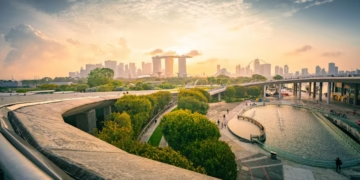
Singapore: A global financial center and a diplomatic bridge between East and West. Its universities, like the National University of Singapore (NUS) and Nanyang Technological University (NTU), are highly ranked and offer a strategic Asian perspective on global issues.
-
Beijing, China: For those seeking to understand the rising superpower from within, Beijing is indispensable. Universities like Peking University and Tsinghua University are China’s best, offering deep insights into Chinese foreign policy and governance.
Choosing the Right City for You: A Practical Checklist
Selecting your destination requires introspection. Ask yourself:
A. Career Focus: Do you see yourself in multilateral diplomacy (Geneva), national foreign policy (D.C./London), humanitarian work (Geneva/NYC), or academic research (Boston)?
B. Language Skills: Are you proficient in another language like French or Mandarin? Choosing a city where you can use and improve that skill is a strategic advantage.
C. Financial Reality: Honestly assess your budget. Consider tuition differences (UK/US vs. Continental Europe), availability of scholarships, and living costs. Don’t underestimate the financial strain.
D. Cultural Fit: Do you thrive in the fast-paced, competitive environment of London and D.C., or prefer the more structured, quiet professionalism of Geneva?
E. Long-Term Goals: Do you want to build a network and seek employment in a specific region after graduation? Studying there is the most effective way to do so.
Conclusion: Your Passport to a Global Career
Ultimately, the “best” city for your Global Studies degree is a deeply personal choice that aligns with your academic interests, professional aspirations, and personal circumstances. London, Washington D.C., and Geneva represent the traditional power bases, each with a distinct flavor. Paris and Boston offer unparalleled academic prestige within rich cultural and intellectual environments. Cities like Berlin, Singapore, and Beijing represent the shifting poles of global power, offering forward-looking perspectives.
Investing time in choosing your city is the first strategic decision of your global career. It is an investment in not just an education, but an experience that will shape your worldview, your network, and your future. Choose wisely, and you will gain not just a degree, but a passport to the world stage.